

Microsoft’s ‘Project Silica’ targets glass as the archival storage medium of the future - barnescousine

Microsoft
In contrast to Microsoft's new Edge browser, natural-language querying in Excel and other near-term Microsoft innovations, one of the more interesting announcements youNorth Korean won't see anytime presently is storing data within glass: Project Silica.
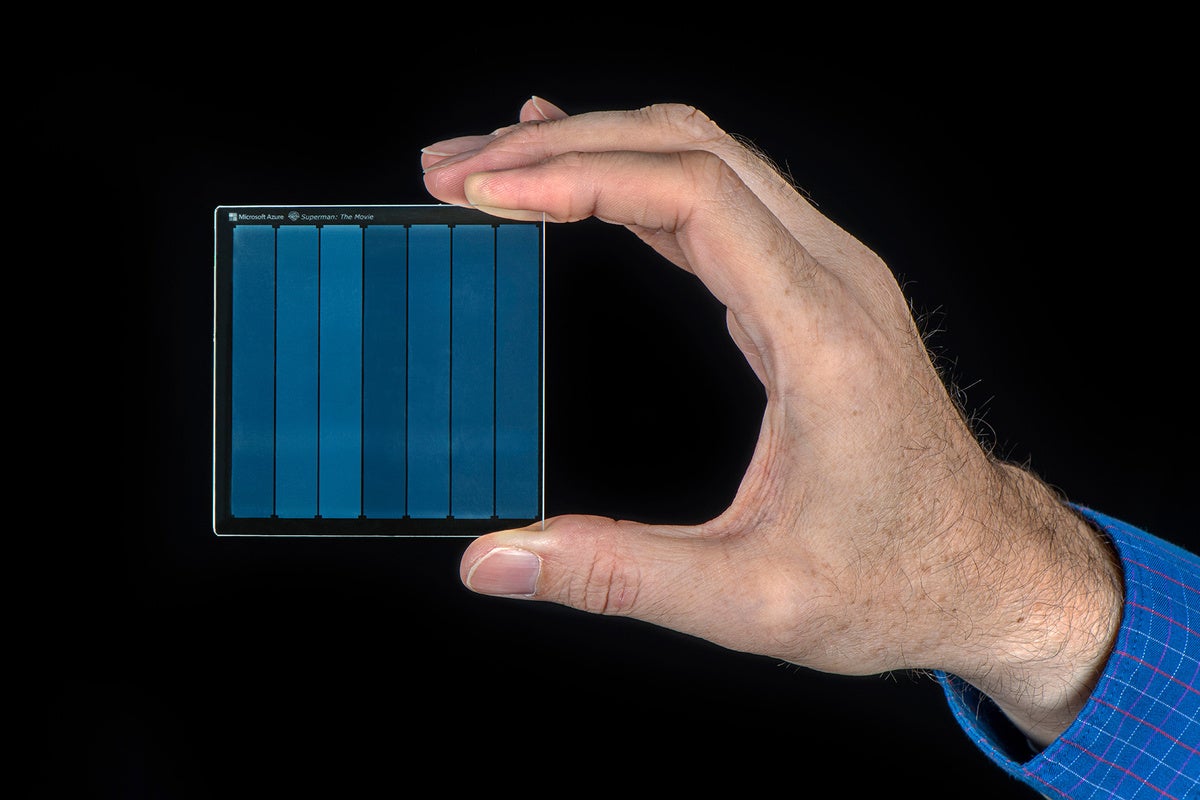
At Microsoft Wake, the company showed off how it developed (with help from the Warner Bros. film studio apartment) a three-dimensional transcription system to memory boar the movieSuperman within a pane. Using "voxels," a three-dimensional variation of the pixels that display images on a PC monitor, Microsoft was able to store the digital version of the movie inside a Project Silicon dioxide glass. More than 100 layers of voxels can be stored on a sheet of glass 2 millimeters thick.
 Microsoft
 A closeup of the Protrude Silica glass.
In 2016, Microsoft began showing sour how it could use DNA strands to store data, as a biologic analogue to traditional disk- OR flash-based storage. Glass storage is arguably Thomas More practical, as Microsoft tried it by boiling the glass, detrition it with brand fleece, and even mircrowaving it without any degradation of the data. Infrared layers distort the glass, somewhat like traditionalistic DVD recording media, but do and then inside the glass and away from the surface air. The information is read backmost using lasers, Microsoft said in a blog carry about Project Silica, and machine learning is used to decrypt the light As it reflects off of the glass.
As Microsoft'sSuperman demo indicates, the move depict industry might be one client concerned in a storage technology like this. Analog film is notoriously fragile, affected to rot and other disintegration. Many early films have been entirely lost because the original negatives deteriorated relevant of no return. Film studios store doubled copies in multiple locations, even separating the color information and then reconstructing information technology if necessary, simply that's a costly and laborious process.
Patc Microsoft's presentation obviously puts this solution past the abstractive stage, it's not quite an ready for production.Variety, which received an in spite of appearanc look at the engineering, reports that Microsoft doesn't yet have commericially available product equipment to record and write data. Information technology's also not quite clear how much data can be stored per cubic millimeter, operating room how aware the data can actually last, among other questions that have yet to be publicly answered.
Still, archival data is a problem that computer memory companies have restfully proved to solve, especially as factors ilk "disc rot" quietly erode CDs and DVDs from years past. Can hard drives spin forever? No. Capacity providers take over to balance the unfailing maintenance of a storehouse solution like a server with the cost of preserving data that may be affected once or double in a xii eld. Methamphetamine may exist the answer, but there's still work to be through.
Note: When you purchase something after clicking links in our articles, we may earn a small commission. Read our affiliate link insurance for more inside information.
As PCWorld's senior editor, Mark focuses on Microsoft news and chip technology, among other beatniks. He has formerly inscribed for PCMag, BYTE, Slashdot, eWEEK, and ReadWrite.

Source: https://www.pcworld.com/article/398316/microsofts-project-silica-targets-glass-as-the-archival-storage-medium-of-the-future.html
Posted by: barnescousine.blogspot.com
0 Response to "Microsoft’s ‘Project Silica’ targets glass as the archival storage medium of the future - barnescousine"
Post a Comment